Blog

  • How To Avoid UPI Fraud? PhonePe Shares 3 Checks Every User Must Follow

    How To Avoid UPI Fraud? PhonePe Shares 3 Checks Every User Must Follow

    UPI has made digital payments quick and convenient. But scammers are finding new ways to exploit users, from fake payment requests to impersonation and remote access scams.

    In an exclusive communication with NDTV, PhonePe shared three basic checks for users to protect their money:-

    1. Never Enter Your UPI PIN To Receive Money

    A UPI PIN is required to authorise payments from your bank account, not to receive money. Fraudsters may send fake payment requests or QR codes, claiming they will transfer money or issue a refund. If a transaction asks for your UPI PIN, check it carefully. Entering the PIN can authorise a debit from your account.

    2. Verify The Recipient’s Name Before Paying

    Before completing a UPI transaction, check the registered bank account name displayed on the payment screen. Scammers may use fake profiles or misleading UPI IDs to impersonate friends, family members or businesses. If the name does not match the intended recipient, stop the transaction and verify the details independently. Be wary of strangers offering to transfer money digitally in exchange for cash. Such offers could be part of a fraud.

    3. Never Share OTPs Or Click Unknown Links

    Fraudsters often pose as bank officials, telecom representatives or customer support agents to trick users into sharing sensitive information. Never disclose your OTP, UPI PIN or banking details over calls, messages or emails. Do not click suspicious links or install screen-sharing apps at the request of unknown callers. Such apps can give scammers access to your phone and expose sensitive information. PhonePe has also warned users against money mule scams. In these cases, people are tricked into receiving and transferring money linked to illegal activities. Even unknowingly handling suspicious funds can lead to frozen bank accounts and legal complications.

    What To Do If You Fall Victim To UPI Fraud

    Act quickly if you suspect that your account has been compromised or money has been stolen. PhonePe users can raise a complaint through the Help section of the app or contact customer care at 080-68727374 or 022-68727374.

    For further action, report the incident to the national cybercrime helpline at 1930 or file a complaint at the National Cyber Crime Reporting Portal. Suspicious calls, messages and fraudulent WhatsApp or Telegram activity can also be reported through the Chakshu facility on the Sanchar Saathi portal.

    The key is to verify every payment request, protect your authentication details and report suspected fraud without delay.

  • 2 Men Try To Snatch Telangana Woman’s Chain, She Thrashes Them With Sticks

    2 Men Try To Snatch Telangana Woman’s Chain, She Thrashes Them With Sticks

    Hyderabad:

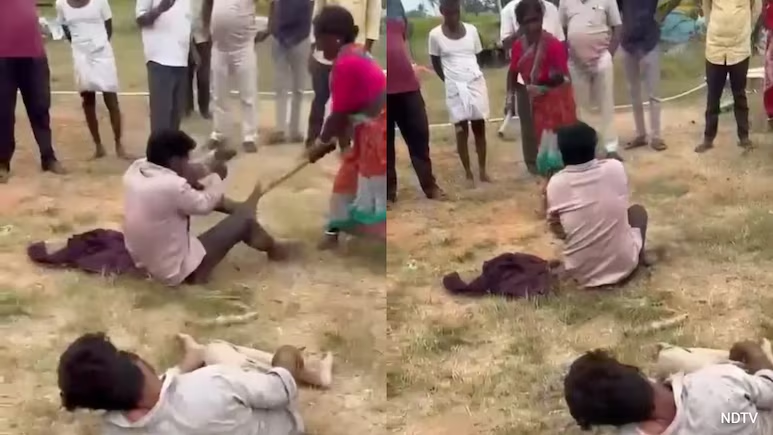
    In a dramatic incident in Telangana’s Sangareddy district, a woman farmer fought back against two alleged chain snatchers and thrashed them with a stick after local farmers caught them while they were attempting to escape on a motorcycle.

    The incident took place on Thursday, when the woman, identified as Kishtamma, was working in an agricultural field and two men approached her on a motorcycle and pretended to ask for directions. During the interaction, they allegedly attempted to snatch her gold mangalsutra, weighing approximately three tolas (30 gm).

    The suspects then tried to flee on their motorcycle. However, Kishtamma raised an alarm and resisted the robbery. Her cries for help alerted farmers working in nearby fields, who immediately chased the suspects and managed to catch them.What followed next was not something the theives had expected. The woman confronted the suspects and beat them with a wooden log and recovered the stolen mangalsutra.

    Jinnaram police rushed to the spot and took both suspects into custody after learning about the incident.

    Both the snatchers were identified as Vadde Sailu, a resident of Mucherla village, and Aravind, from Meenampally village, both in Hathnoora mandal of Sangareddy district. The duo have previous criminal records, with involvement in four earlier theft cases.

  • ISRO’s ‘Smart Boy’ Rocket To Launch Key ‘Swadeshi’ GPS Satellite Today. Why It Matters

    ISRO’s ‘Smart Boy’ Rocket To Launch Key ‘Swadeshi’ GPS Satellite Today. Why It Matters

    New Delhi:

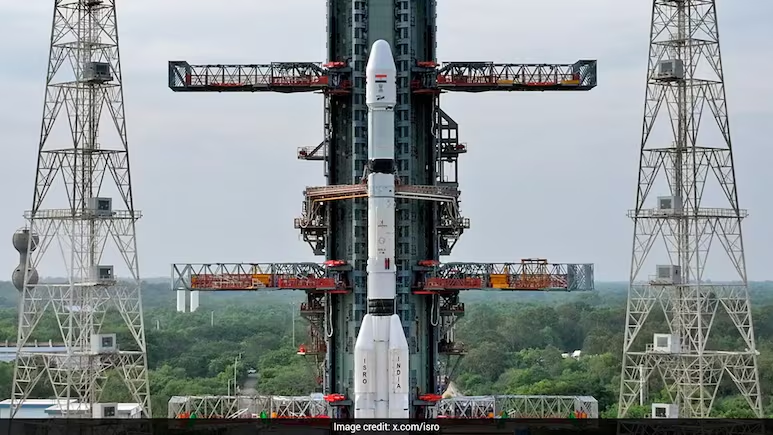
    The Indian Space Research Organisation (ISRO) is set to launch India’s next-generation navigation satellite, NVS-03, today, using the Geosynchronous Satellite Launch Vehicle (GSLV), a ‘naughty boy’ now dubbed the ‘smart boy’.


    The GSLV-F18 rocket is scheduled to lift off at 11.51 pm from the second launch pad at the Satish Dhawan Space Centre (SDSC-SHAR) in Andhra Pradesh’s Sriharikota.

    The key mission will strengthen the country’s indigenous NavIC, or the navigation constellation, a ‘swadeshi’ GPS of sorts. The launch will place the next-generation satellite into Geosynchronous Transfer Orbit, boosting India’s capability to provide accurate positioning, navigation and timing services across the country and beyond when it reaches its home in space.

    With several NavIC satellites having failed over the years, the launch comes at a critical time as Operation Sindoor — India’s precision air strikes on nine terror infrastructures in Pakistan and Pakistan-occupied Kashmir in response to the Pahalgam terror attack last year — underscored the need for a reliable sovereign navigation network.

    Equipped with an indigenous atomic clock and new-generation capabilities, NVS-03 will strengthen India’s strategic space architecture and help restore the country’s long-delayed and occasionally hobbled ‘swadeshi’ GPS constellation.

    The launch also comes at a time when India is seeking greater strategic autonomy in an increasingly uncertain geopolitical environment. The satellite is the third in the series of second-generation navigation satellites and the twelfth satellite in the Indian Regional Navigation Satellite System, also known as IRNSS-1L.

    ISRO says the satellite will provide continuity to navigation services and strengthen the existing NavIC constellation, India’s answer to the American GPS, Russian GLONASS, European Galileo and Chinese BeiDou systems.

    NavIC, short for Navigation with Indian Constellation, was conceived after the 1999 Kargil War.  During that conflict with Pakistan, India realised the strategic vulnerability of depending on foreign navigation systems. Access to high-quality GPS information was restricted, highlighting the need for an independent capability. The lesson was simple and enduring. A major power cannot depend entirely on another country’s satellites for critical military and strategic operations.

    Nearly three decades later, that lesson still remains relevant.

    Why NVS-03 Is Important

    The need for a robust sovereign navigation capability has again come into sharp focus during Operation Sindoor, which was launched on May 7, 2025.

    India reportedly deployed more than 50 satellites from its extensive space-based assets to support surveillance, communications, reconnaissance, weather monitoring and strategic operations. Yet the incomplete condition of the NavIC constellation remained a concern. Despite years of effort and significant investment, the indigenous navigation system had not reached its full potential because of a series of satellite failures.

    The setback has been severe. Eleven satellites have been launched for the NAvIC constellation so far, but failures of payloads and especially atomic clocks have reduced operational capability. India ideally requires a minimum of seven functioning navigation satellites for seamless regional coverage. At various points, only a handful remained fully operational. Industry and strategic experts have frequently described this as one of the weakest links in India’s otherwise impressive space infrastructure.

    That is why the launch of NVS-03 carries significance far beyond a routine satellite deployment.

    The new spacecraft is designed to augment the existing constellation and bring greater robustness and reliability. ISRO says the satellite carries an indigenous atomic clock along with procured atomic clocks. The indigenous clock represents an important technological milestone. Atomic clocks are the heart of any navigation system because positioning accuracy depends on extremely precise timing measurements. Even a tiny timing error can translate into large positioning errors on the ground.

    Some of India’s earlier navigation satellites suffered atomic clock problems, significantly affecting system performance. Failures of imported rubidium atomic clocks became one of the most discussed challenges in the NavIC program. Those problems prompted Indian scientists to develop indigenous capabilities. The use of a domestically developed atomic clock on NVS-03 is therefore a major technological achievement and could enhance long-term reliability.

    NavIC is designed to provide highly accurate Position, Navigation and Timing (PNT) services over India and an area extending approximately 1,500 kilometres beyond the country’s landmass. This wide coverage zone includes the Indian Ocean region, making the system strategically important for civilian transportation, fisheries, shipping, aviation, disaster management and military operations.

    The system provides two categories of service. One is the Standard Positioning Service available for civilian users. The other is a more restricted service intended for authorised strategic and defence users. Accurate navigation has become indispensable in modern warfare where everything from aircraft and drones to missiles and troops depend upon reliable positioning data.

    The new generation of NVS satellites is also introducing improvements. NVS-03 carries the new L1 signal in addition to the existing L5 and S-band signals. This is important because L1 is widely used by commercial navigation devices across the world. The addition could improve compatibility with mass-market receivers, smartphones, smartwatches and navigation equipment while broadening adoption of NavIC across civilian sectors.

    The launch vehicle itself has a significant history.

    GSLV’s 20th Flight

    GSLV-F18 marks the twentieth flight of the GSLV program. Over the years, the rocket has evolved from a vehicle plagued by setbacks into a dependable launcher. The program experienced several failures in its early years, particularly while mastering cryogenic propulsion technology. Yet those difficulties eventually led to one of ISRO’s greatest technological successes, the indigenous cryogenic engine program.

    Standing about 50 metres tall and weighing roughly 420 tonnes at liftoff, the three-stage rocket combines solid, liquid and cryogenic propulsion systems. Its upper cryogenic stage allows it to place heavy satellites into Geosynchronous Transfer Orbit, the destination required for many communications and navigation spacecraft.

    The GSLV family has become one of ISRO’s most important workhorses. It has launched major communications satellites, weather satellites and navigation spacecraft. More recently, variants of the rocket family have also supported landmark international missions including the launch of the NASA-ISRO Synthetic Aperture Radar, or NISAR, mission, one of the most sophisticated Earth observation collaborations ever undertaken between India and the United States costing $ 1.3 billion.

    For ISRO, the NVS-03 launch is also important from an organisational perspective. It will be the space agency’s third launch of 2026. The year has already seen both success and disappointment. Following one successful mission and one failed mission, ISRO will be keen to demonstrate consistency and restore momentum as it works through an ambitious launch schedule.

    The mission profile remains straightforward. GSLV-F18 will lift off from the Second Launch Pad at the Satish Dhawan Space Centre in Sriharikota and place the 2,250-kilogram NVS-03 satellite into Geosynchronous Transfer Orbit after its 20-minute flight. From there, the satellite will use onboard propulsion to reach its final position and begin operational service for the NavIC network.

    The strategic urgency surrounding NavIC has increased in recent years. Satellite navigation is no longer merely a convenience for map services and vehicle tracking. It underpins military operations, critical infrastructure, banking networks, telecommunications, shipping, aviation and emergency response systems. Any disruption or denial of access can have significant national security implications.

    India’s policymakers increasingly view space infrastructure as a strategic asset comparable to physical infrastructure on the ground. The country’s experience after the Kargil conflict and the continuing security challenges in the region have reinforced the importance of independent sovereign capabilities.

    That is why NVS-03 is not expected to be a standalone fix. Additional satellites are already in the pipeline. NVS-04 and NVS-05 are expected to follow in subsequent launches. Together they are intended to rebuild redundancy, strengthen coverage and restore the full capability of the constellation. A navigation system requires not only operational satellites but also backup capacity to ensure uninterrupted service when individual spacecraft age, fail or need replacement.

    For India, the objective is straightforward: create a resilient, sovereign navigation network that remains available regardless of international political circumstances or access restrictions.

    The coming launch therefore represents an important milestone in India’s strategic space journey. It is the latest step in an effort that began after the Kargil War, suffered repeated technical setbacks, faced atomic clock failures and years of delays, yet continued through persistence and technological innovation.

    If successful, NVS-03 will not merely add another satellite to orbit. It will help repair a critical gap in India’s strategic architecture, strengthen the country’s indigenous navigation capabilities and move NavIC closer to the robust operational constellation that India has sought for more than two decades.
  • Analysis: Drugs, Not Panthik Grievances, Are Driving Punjab’s 2027 Race

    Analysis: Drugs, Not Panthik Grievances, Are Driving Punjab’s 2027 Race

    Chandigarh:

    For decades Punjab’s politics ran on Panthik lines – Sikh identity, religious institutions, historical grievances, and the old Akali-versus-everyone axis. That frame is losing ground. The drug crisis and the everyday sense that the streets are not safe have pushed identity questions to the side. People are more worried about whether their sons will survive than about old theological or autonomy debates.

    Amit Shah’s recent string of visits made the change plain. Instead of touching the usual flashpoints, he went straight to families of anti-drug activists and ordinary people killed or driven to despair after they confronted peddlers – cases in Mansa, Gurdaspur and Sangrur. He talked about synthetic drugs, overdose deaths and the targeting of those who speak up. For most voters in the villages and towns, the urgent questions are basic security, jobs for young people and keeping families away from chitta (synthetic drugs). Identity politics does not put food on the table or stop a syndicate.

    The ruling AAP is under pressure. Eradicating drugs was a central promise of its 2022 win. By keeping the spotlight on continuing supplies, deaths and activist killings, the BJP has hit the party where its credibility is thinnest. Shah’s visits and calls for CBI probes force AAP into a defensive crouch – explaining its policing record instead of talking about free power or clinics. The Centre’s charge that the trade needs political cover adds heat and draws sharp replies from the Bhagwant Mann government.

    Whether this turns into votes for the BJP is less certain. The party is using the issue to look like a serious alternative in a state where it has long been weak outside urban trading pockets. It is still building a rural organisation. That is why talk of some understanding with the Shiromani Akali Dal keeps surfacing. Both sides have reasons to send a message, even if the Akalis carry their own baggage on Panthik questions and an alliance would not be simple.

    The principal fight remains between AAP and Congress. Both have had turns in power – Congress from 2017, AAP from 2022 – and both failed to bring the drug problem under control. The BJP’s opening is the chance that enough people will treat it as a third option that might actually do something about the daily toll. If the drug issue stays primary and the Panthik ones stay secondary, the party can squeeze the others. If not, the old lines reassert themselves.

    Sacrilege still sits underneath. The 2015 Bargari case, the Behbal Kalan and Kotkapura firings that killed two protesters, and the decade of stalled trials continue to anger people. Successive governments promised quick justice and delivered little. That memory does not vanish just because drugs have taken the headlines.

    But for now, the shift the piece describes is real but incomplete. Drugs and law-and-order have moved to the front of ordinary conversation because the numbers are visible and personal: overdose deaths continue, young men disappear into addiction, and a string of anti-drug activists have been killed or threatened. Those facts cut across caste and party lines in a way that older Panthik grievances sometimes do not. When Amit Shah visits the families of people killed after confronting peddlers in Mansa, Gurdaspur or Sangrur, he is not inventing the problem; he is forcing the camera onto it. That makes AAP’s 2022 promise look unfinished and keeps the Mann government answering questions about policing rather than about free power or clinics.

    For the BJP, the calculation is straightforward but narrow. By staying on drugs, it can damage AAP’s core claim and present itself as the only party not yet stained by a full term in power. The difficulty is conversion. The party’s rural presence remains thin outside a few pockets. Without local faces and cadres, public anger at AAP does not automatically become BJP votes. That is why the idea of some understanding with the Shiromani Akali Dal keeps returning. The Akalis bring residual rural networks and a Panthik vocabulary the BJP lacks, but they also carry the memory of the earlier drug years and the sacrilege period under their own watch. Any joint message would have to paper over those contradictions; many voters would notice.

    Congress sits in a similar bind. It governed from 2017 to 2022 and could not reverse the drug trade. Its current critique of AAP therefore sounds familiar rather than fresh. The main contest remains AAP versus Congress, with the BJP trying to turn itself into a viable third pole on a single issue. Whether that works depends less on rhetoric than on whether the drug numbers keep rising and whether the BJP can look like more than a Central agency operating through local intermediaries.

    Drugs have earned their place as the leading practical issue because they produce bodies every week and have survived two different ruling parties. That is not a media construction; families in the villages can name the dead. The BJP is right to keep pressing it. The visits, the calls for central probes, and the refusal to treat the problem as solved are politically effective because they match what people already see. AAP is weakest exactly where its 2022 mandate was strongest.

    Yet the strategy has a ceiling. Treating every death and every stalled case as pure proof of AAP’s unique failure ignores the longer record. The trade flourished under previous governments as well. If the BJP’s message stays only at “AAP failed,” it risks sounding like another party using the crisis rather than a party prepared to run the police and the borders differently. Voters who already feel let down by both Congress and AAP will give the BJP a hearing. They will not treat it as a blank cheque if the party appears mainly interested in keeping the issue alive for 2027.

    Sacrilege still matters for a different reason. It is not the daily emergency that chitta has become, but it is the clearest example of a promise that every party has made and none has fully kept. As long as those trials remain unfinished, any party that campaigns only on “we will fix drugs” while remaining silent or evasive on the older cases will look selective. Punjab’s electorate has a long memory for both kinds of failure.

    The ground has shifted enough that pure Panthik mobilisation is harder than it was a decade ago. It has not shifted so far that identity and institutional questions can be ignored. The BJP can keep AAP on the defensive and force the conversation onto policing and patronage.

    Turning that into a durable vote share still requires the party to show it can operate in rural Punjab without looking like an outsider or simply a vehicle for Central agencies. If the drug deaths continue and the older cases stay unresolved, enough voters may decide that trying the remaining option is worth the risk. They will also notice if that option treats the deaths mainly as campaign material. Punjab rarely abandons one set of grievances for another in a single cycle; it usually carries both.

  • “Might Be Crocodiles Here, But”: BJP MP Takes Yamuna Dip, Declares It Clean

    “Might Be Crocodiles Here, But”: BJP MP Takes Yamuna Dip, Declares It Clean

    New Delhi:

    A dip, a sip, a grand declaration and a political dare. The Yamuna is once again at the centre of a political storm in the Capital.

    BJP MP Manoj Tiwari took a dip in the river at Sonia Vihar ghat on Thursday, claiming that pollution levels had dropped by half over the past year, thanks to the cleaning work undertaken by the Rekha Gupta government.

    The BJP leader went a step further, asserting that people could now celebrate Chhath Puja in the Yamuna once again.

    Tiwari, who represents the North East Delhi Lok Sabha constituency, said the presence of migratory birds at certain stretches of the river indicated an improvement in its condition. “These birds would not have come here if the river wasn’t clean,” he asserted, adding that “there might be crocodile in water here but crocodiles come only in clean water”.

    He also claimed to have performed aachman (ritual sipping of water) at Sonia Vihar, praising the BJP government for its efforts to clean the river and accusing the AAP of failing to do so.

    “AAP used to blame Haryana for polluting the river. Since the BJP came to power, it has cleaned half of the river in one-and-a-half years,” Tiwari claimed, adding that the remaining work would be completed over the next three years.

    In a post on X, the Delhi BJP claimed that the work undertaken by its government in two years had achieved what the Congress and AAP could not in 27 years. It also challenged former Delhi Chief Minister Arvind Kejriwal to take a dip in the river.

    AAP’s Counter-Dare

    The AAP’s response was swift. The party’s Delhi president and former minister, Saurabh Bharadwaj, wrote on X: “These BJP frauds know nothing about Delhi. It is well known that the 26-km stretch of the Yamuna from Palla to Wazirabad has always been comparatively clean. It was cleaner during the AAP government, even according to DPCC reports.”

    The Yamuna becomes increasingly polluted as it flows downstream through Delhi. The 22-km stretch between Wazirabad and Okhla is considered particularly polluted and has been the focus of multiple government interventions.

    Bharadwaj then threw down a counter-challenge.

    “I invite Manoj Tiwari and Water Minister Parvesh Verma to drink water at Kalindi Kunj ghat (near Okhla barrage). Last year also, they ran away from the challenge,” he wrote.

    Forget The Dare, Look At The Data

    But can one dip in the river establish that its water is safe for the millions of devotees preparing to celebrate Chhath?

    NDTV Datafy’s analysis of DPCC monitoring data reveals a striking picture of the Yamuna as it flows through Delhi.

    Biochemical Oxygen Demand (BOD), which measures the amount of oxygen required by microorganisms to break down organic waste in water, is a key indicator of river health. Higher BOD levels generally indicate greater organic pollution.

    The prescribed bathing-water standard for BOD is 3 milligrams per litre (mg/l) or less. However, readings from several monitoring points along the Yamuna have consistently remained above this threshold.

    At Palla, where the river enters Delhi, the BOD level stands at 2 mg/l, within the prescribed bathing-water limit.

    But the picture changes dramatically downstream.

    At the ISBT Bridge, BOD shoots up to 30 mg/l, while at ITO, it stands at 18 mg/l. Both readings are significantly above the prescribed limit.

    There has been some improvement, though. At ITO, BOD levels have fallen from 70 mg/l in July 2025 to 18 mg/l in September 2026.

    That is progress. But the current reading is still six times the prescribed limit.

    The faecal coliform count, which indicates contamination from human and animal waste, is even more concerning.

    At the ISBT Bridge, the count stands at 35,000 MPN per 100 millilitres. The upper desirable limit for bathing water is 2,500 MPN per 100 millilitres – making the reading 14 times higher.

    In other words, some stretches of the river may have become cleaner, but that is a far cry from declaring the Yamuna safe.

    The River Still Has A Long Way To Go

    The political claims and counterclaims come amid ongoing efforts to clean the Yamuna, which flows for around 52 km through Delhi.

    Just days ago, Union Home Minister Amit Shah launched 43 projects worth Rs 8,941 crore aimed at cleaning the river. He also pledged that the BJP government would ensure that the Delhi stretch of the Yamuna was cleaned by May 2029.

    Earlier, Delhi Water Minister Parvesh Verma had acknowledged that the task would take time.

    “It will take around two-and-a-half to three years for the Yamuna to be completely clean. We have never claimed that the Yamuna has been completely cleaned,” he had said.

    The minister maintained that the stretch between Palla and Wazirabad had been completely cleaned, while work was underway on the stretch between Wazirabad and Kalindi Kunj.

  • PM Modi Holds Roadshow In Gujarat During Two-Day State Visit

    PM Modi Holds Roadshow In Gujarat During Two-Day State Visit

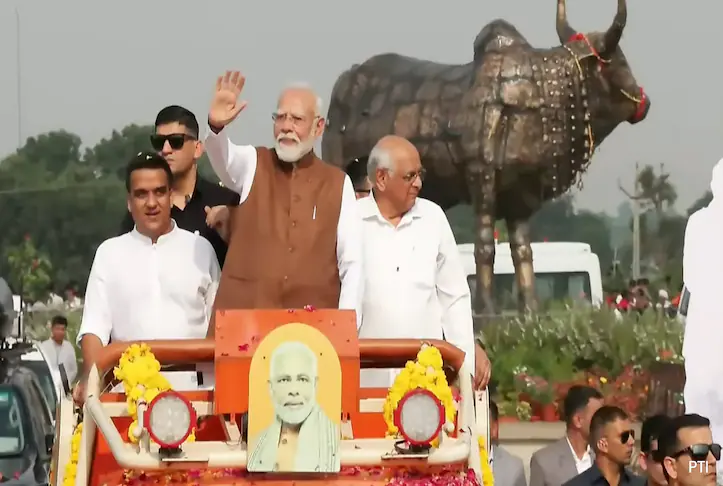
    Prime Minister Narendra Modi on Friday held a roadshow in Bhildi town in Gujarat’s Banaskantha district, where he arrived to inaugurate and lay the foundation for development works worth Rs 14,000 crore and to release the 24th installment of the PM-KISAN scheme.

    PM Modi travelled in an open jeep, accompanied by Chief Minister Bhupendra Patel and Deputy Chief Minister Harsh Sanghavi, and held the roadshow from the helipad to the Banas Dairy plant in the village.

    People gathered in large numbers on both sides of the road to greet him. PM Modi waved at the crowds, who shouted his name and raised various slogans.

    They also carried placards bearing the slogan, “Jab tak Bharat viksit nahi hoga, Modi kahin nahi jayega” (PM Modi will not go anywhere until India is developed).

    The placards also said that “Modi will not go anywhere till India becomes self-reliant”. Another placard read, “Modi will not go anywhere till India becomes one of the top economies of the world”.

    These were apparently in response to Congress president Mallikarjun Kharge’s recent remark that even “Modi’s father will have to go”.

    PM Modi is on a two-day visit to Gujarat. On Saturday, he will attend the Ekta parade in Ekta Nagar, Kevadia, and lay the foundation stone and inaugurate various development projects.

  • “Wants To Kill Me”: Wife Says No To Karwa Chauth Fast, Man Files Complaint

    “Wants To Kill Me”: Wife Says No To Karwa Chauth Fast, Man Files Complaint

    A bizarre complaint was received by Madhya Pradesh Police on Thursday. A man from Shivpuri threatened to divorce his wife over her refusal to celebrate Karwa Chauth, a fast observed by married Hindu women to pray for the long life of their husbands. The man has alleged that his wife wants to kill him.

    The complainant, identified as Barelal Adivasi, a native of Bijrawan village in Shivpuri, said his wife, Mithilesh Adivasi, is being “unfaithful” to him.

    “Mere liye Karwa Chauth ka vrat nahi rakh rahi hai aur mujhe maarna chahti hai (She is not observing the Karwa Chauth fast for me and she wants to kill me),” Adivasi wrote in his complaint.

    “Na hi mere liye chaand ki puja kar rahi hai. Maine kaha tu chaand dekh ke jis se meri umar badh jaaye magar who mujhe maarna chah rahi hai (She is not performing the moon-worship for my sake. I had asked her to look at the moon, a ritual followed for a husband’s long life, but she seems to want me dead).”

    The man threatened that if his wife fails to celebrate Karwa Chauth and observe the fast for his well-being, he will divorce her. With this complaint, he urged the police to take appropriate action.

    Following the written appeal, the police swung into action.Sanjay Mishra, Sub-Divisional Police Officer, Kolaras, Shivpuri said that with the help of a woman police officer, they will try to resolve the rift between the couple

  • Family Against ‘Acting’ Wish, Teen Jumps To Death From Greater Noida Building

    Family Against ‘Acting’ Wish, Teen Jumps To Death From Greater Noida Building

    Noida:

    An 18-year-old student pursuing a Bachelor of Business Administration (BBA) died by suicide after jumping from the 19th floor of a high-rise building in Greater Noida on Thursday morning.

    The incident took place around 4 am in Greater Noida’s Pristine Avenue Society.

    According to the police, the student, Aditya Arora, lived with his family in the complex’s Tower A. On the day of the incident, he left home early in the morning without informing anyone and went to the 19th floor of Tower B and jumped to his death.

    Preliminary investigation revealed that Arora was pursuing a first-year BBA at a private college in Ghaziabad. He wanted to become an actor, but due to the family’s pressure, he enrolled in the BBA course. However, it is not yet determined whether academic confusion was the reason behind his death.

    Arora’s family members told the police that he was upset over something for the past few days.

    The exact reason for his anger, and whether it was directly related to his studies, remains unclear.

    According to reports, there have been no reports of scolding or any family dispute prior to the incident.

    Town in-charge Ranjeet Singh said that no note was recovered from the scene.

    The student is survived by his parents and a younger brother.

    His body has been sent for post-mortem, and the police are conducting further investigation, officials said.

  • 3 Rescued After Under-Construction Building Collapses In UP’s Bulandshahr

    3 Rescued After Under-Construction Building Collapses In UP’s Bulandshahr

    An under-construction two-storey building collapsed in Chhatari town of Uttar Pradesh’s Bulandshahr district early Friday, trapping three people under the debris.

    Rescue teams responded swiftly and managed to pull all three victims, including a woman, out safely. Police officials said the woman is in stable condition, while the two injured men were rushed to a hospital for treatment.

    According to preliminary reports, the building suddenly collapsed at around 1 a.m. while construction work was underway. The collapse triggered panic in the area, prompting local residents to alert the authorities. Soon after, police personnel, district administration officials, firefighters, and teams from the SDRF and NDRF reached the site and launched a rescue operation.

    An Additional District Magistrate (ADM) from the Finance and Revenue Department said authorities received information that three people were trapped beneath the rubble of the collapsed structure in the Chhatari police station area. Emergency response teams, including the fire department, NDRF, MDRV unit, and local administration, were immediately deployed to the location.During the rescue operation, all three victims, comprising one woman and two men, were successfully extracted from the debris. While the woman did not sustain serious injuries, the two men were sent to a medical facility for immediate care.

    The ADM further stated that SDRF personnel and a Multi-Disaster Response Vehicle from neighbouring Aligarh district were also called in to assist. Rescue efforts were carried out through coordinated action involving the police, administration, and fire department. NDRF teams also conducted a canine search at the site to ensure no one else remained trapped.

    Earlier, on October 26, two people died after slabs of a building collapsed at Milan Garden in the Harsh Vihar area of Northeast Delhi.

    The victims, who were trapped under the debris, were rescued and rushed to a hospital, where doctors declared them dead.

    The incident occurred when a new floor was being constructed above an old house. During the construction work, a portion of the existing roof gave way, causing the newly laid slab above it to collapse as well, trapping two people under the rubble.

  • Will Keep Walking Till Congress Government Falls: Telangana BJP MP Launches Padayatra

    Will Keep Walking Till Congress Government Falls: Telangana BJP MP Launches Padayatra

    Hyderabad (TG):

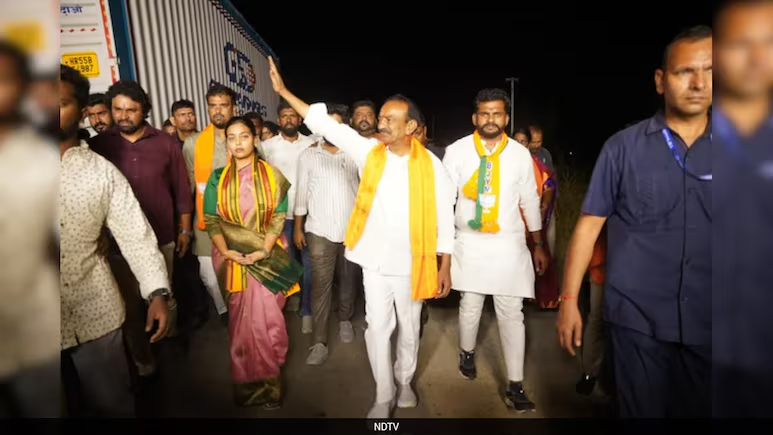
    BJP MP Eatala Rajender has escalated his political confrontation with the Congress government, declaring that he will continue his padayatra not only to demand the removal of the Jawaharnagar dumping yard but also until the Revanth Reddy government is ousted.

    Responding sharply to Congress leaders who allegedly accuse him of having no work and merely wandering around, the Malkajgiri MP said: “The Congress party holds a press conference every three days and claims that this MP has no work. If they think I am wandering around without work, remember, I will continue doing the same work until your government is overthrown.”

    Against the backdrop of Union Home Minister Amit Shah’s high-profile padayatra in Hyderabad on November 2, organised by the Telangana BJP under the slogan “Loktantra Bachao, Arachakata Hatao” (Save Democracy, Remove Anarchy), the remarks made during Rajender’s four-day, 60-km Jawaharnagar Jan Sankalpa Yatra have given the BJP’s campaign a wider political dimension.

    Rajender launched the march from Edulabad on October 27, highlighting alleged pollution caused by the Jawaharnagar dumping yard.

    The political significance of the march has been heightened by BRS working president K.T. Rama Rao’s announcement of a proposed statewide padayatra in 2027. KTR has said the exercise would help reconnect the party with people and address public grievances.

    Telugu political history offers several important precedents linked to padyatra politics.

    Y.S. Rajasekhara Reddy’s nearly 1,470-km Padayatra in 2003 preceded the Congress party’s victory in the 2004 elections. Later, N. Chandrababu Naidu’s 2,817-km Vastunna Meekosam march (2012-13) was followed by the TDP’s return to power in 2014.

    Y.S. Jagan Mohan Reddy’s 3,648-km Praja Sankalpa Yatra (2017-19) preceded the YSRCP’s landslide victory in 2019. The TDP returned to power later after Nara Lokesh undertook the Yuva Galam padayatra.

    Ahead of the 2023 Telangana Assembly elections, Revanth Reddy, then president of the Telangana Pradesh Congress Committee (TPCC), embarked on a major statewide padayatra.

    With Eatala Rajender’s confrontation with the Congress government and KTR’s proposed march, padayatra politics is once again emerging as a prominent feature of Telangana’s political landscape, where Assembly elections are due in 2028.