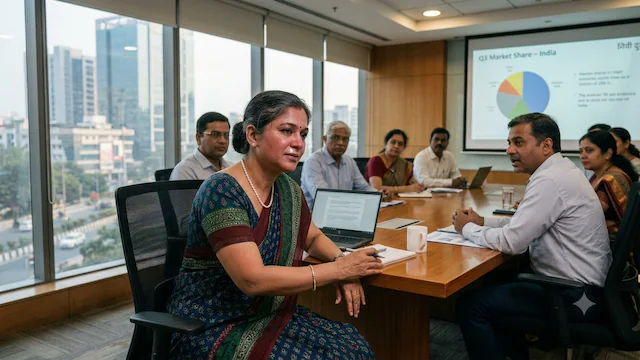
Menopause is often discussed in terms of hot flashes, night sweats, irregular periods and other physical symptoms. But for women in the middle of their working lives, the transition can have consequences that extend well beyond their health. Difficulty concentrating during meetings, forgetting words, struggling with memory and feeling unusually anxious can affect professional confidence and the ability to manage everyday responsibilities at work.
A new study published in the journal Women’s Health examines how women experience menopause and perimenopause in the workplace, highlighting the relationship between health, happiness and productivity. Researchers analysed 130 anonymous Reddit posts to understand how symptoms influence career sustainability, workplace relationships and decisions about professional priorities.
The findings suggest that while some women experience stress, embarrassment and fears about job security, others use this life stage to reassess what they want from their careers. The research also raises an important question for employers: are workplaces equipped to support women through a transition that can coincide with some of the most demanding and senior years of their professional lives?
The issue is relevant in India, where menopause remains a relatively under-discussed workplace health concern, despite the number of women continuing to work through midlife.
How menopause can affect women’s careers
The study, titled “Too hot to handle”: A qualitative analysis of Reddit platform data on the impact of menopause on career sustainability, examined publicly available posts shared between April 2022 and July 2024.
The researchers collected posts from menopause-related communities as well as general workplace and career discussion forums. After reviewing the material, they retained 130 posts describing personal experiences of menopause or perimenopause and their effects on work.
The researchers used a framework that examined three interconnected aspects of career sustainability: health, happiness and productivity.
Their analysis found that menopause could affect all three, sometimes creating a cycle in which symptoms disrupted work performance, and the resulting stress further affected emotional well-being.
1. Brain fog and memory problems can affect workplace confidence
One of the prominent concerns in the posts was cognitive difficulty, commonly described as brain fog. Women reported forgetting words, experiencing memory gaps, struggling to concentrate and losing their train of thought during conversations or meetings.
These experiences could be particularly distressing for women who were accustomed to performing demanding professional roles. Some described feeling embarrassed when they could not recall information or complete tasks as efficiently as before.
The impact was not limited to productivity. Women also reported questioning their abilities, worrying about performance reviews and fearing that colleagues or managers might interpret their difficulties as a decline in professional competence.
The researchers noted that some participants faced disciplinary action or concerns about job security. Others said that a supportive manager helped them manage the difficulties.
2. Fatigue, sleep problems and anxiety can compound the problem
Menopause-related symptoms are not experienced in isolation. Hot flashes and night sweats can disrupt sleep, while fatigue, migraines and mood changes may make it harder to manage a demanding workday.
Women in the study described fatigue, mood swings, anxiety and headaches alongside cognitive difficulties. These symptoms could reinforce one another: disrupted sleep and exhaustion affected concentration, while worries about work performance added to emotional strain.
For some participants, the effort required to maintain a professional image while managing symptoms became an additional source of stress.
3. Some women reconsider their professional priorities
The findings were not uniformly negative. While some women felt that menopause threatened their professional identity or made them less relevant at work, others described the transition as an opportunity to reconsider their priorities.
Some participants wanted to slow down, establish clearer boundaries or move into part-time work. Others explored alternative career paths or considered building independent businesses.
One participant described improved health after moving to a less stressful part-time role.
The researchers suggest that menopause can become a period of career recalibration, with some women placing greater emphasis on health, personal fulfilment and sustainable working arrangements rather than conventional career advancement.
The findings are particularly relevant to India, where workplace discussions about menopause are still limited and women’s experiences can vary significantly depending on their occupation, income and access to healthcare.
A 2026 study published in Frontiers in Global Women’s Health examined menopausal symptoms, work ability and quality of life among 280 employed women aged 45 to 65 in southern India.
It found that 73.2% of the participants reported moderate-to-severe menopausal symptoms. The burden was particularly high among unskilled workers and women in physically demanding occupations.
Sleep problems, fatigue and a reduced ability to carry out usual activities were associated with poorer work ability. Women reporting reduced capacity to perform their regular activities had nearly twice the odds of poor work ability.
The Indian study highlights why menopause at work cannot be viewed only through the experiences of women in corporate offices or senior professional roles. Women working in factories, healthcare, education, domestic work, agriculture and other physically demanding occupations may have fewer opportunities to adjust their schedules, take breaks or work remotely.
For a woman working in a formal office, flexibility around working hours or access to a private space to manage symptoms may make a difference. For someone working in a job that requires prolonged standing, physical labour or fixed shifts, such adjustments may be harder to access.
The Indian findings therefore underline the need for workplace support that accounts for differences in occupation and working conditions.
Leave a Reply