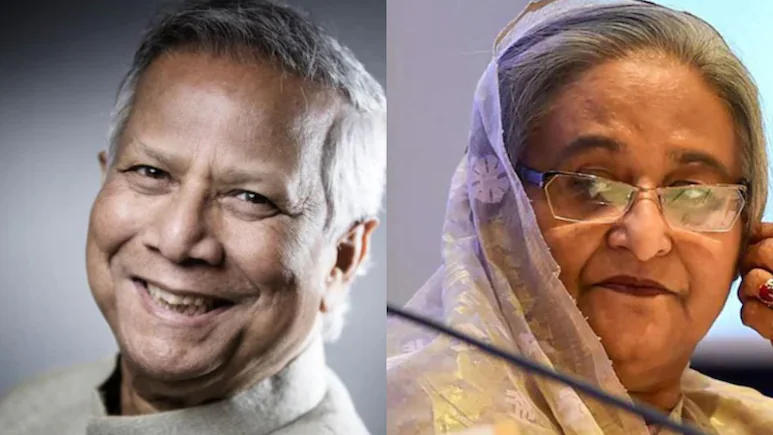
Dhaka: Bangladesh’s political transition following the removal of former Prime Minister Sheikh Hasina has come under renewed scrutiny after Shafiqul Alam, former press secretary to Muhammad Yunus, claimed that student leaders contacted the Nobel Peace Prize laureate before Hasina left the country in August 2024.
In a Facebook post, Alam alleged that the student leaders approached Yunus two days before Hasina’s departure on August 5, 2024, seeking his leadership for a possible interim government. He also credited journalist Qadaruddin Shishir with helping establish contact between the two sides.
What Did Yunus’s Former Press Secretary Claim?
According to Alam, student leaders involved in the 2024 protests wanted to approach Yunus about leading a post-Hasina interim administration. They allegedly sought assistance from Shishir, who was then associated with Agence France-Presse’s (AFP) fact-checking team in Dhaka.
Alam said Shishir acted as an intermediary, facilitating the initial communication between Yunus and the student leaders while Sheikh Hasina was still in power.
Describing the process as a sensitive operation, Alam claimed that only a small number of trusted individuals knew about the discussions. He also praised Shishir for maintaining discretion during a period of political uncertainty in Bangladesh.
Alam further alleged that Shishir began collecting video evidence of killings during the government’s crackdown on protesters.
The account has drawn attention because it suggests that discussions about who might lead a future interim administration were taking place before Hasina left Bangladesh. However, Alam’s statements alone do not establish that the wider uprising or the government’s fall was orchestrated as part of a coordinated plan. The details of the alleged communications require independent corroboration.
How Sheikh Hasina Left Power in August 2024
Sheikh Hasina left Bangladesh on August 5, 2024, following weeks of student-led protests and escalating political unrest. The demonstrations initially centred on public-sector job quota reforms before expanding into a broader movement demanding her resignation.
Muhammad Yunus subsequently returned to Bangladesh and took office as chief adviser of the interim government on August 8, 2024.
His administration remained in office until February 2026, when Bangladesh’s post-election political transition brought Tarique Rahman to the prime minister’s office.
Sheikh Hasina’s Legal Case and Allegations of Political Repression
In November 2025, Bangladesh’s International Crimes Tribunal sentenced Hasina to death in absentia over her role in the deadly crackdown on the 2024 protests. Hasina rejected the proceedings and described the verdict as politically motivated.
The interim government had also banned the activities of Hasina’s Awami League party in Bangladesh and sought her extradition from India. The party remains banned from participating in elections under the restrictions in force as of October 2026.
Hasina has separately accused the former Yunus-led administration of pursuing politically motivated cases against Awami League members and failing to ensure accountability for violence. These allegations remain contested and should be distinguished from established judicial findings.
Muhammad Yunus Heckled at New York Airport
In a separate development, former interim chief adviser Muhammad Yunus was confronted by protesters at New York’s John F. Kennedy International Airport in October 2026.
Videos circulated on social media showed people shouting accusations at Yunus as he was leaving the airport. Bangladeshi media reports identified several of the protesters as individuals linked to the Awami League, whose activities remain banned in Bangladesh.
The incident prompted criticism from Bangladeshi officials, who said the matter should be investigated and that appropriate action should be considered against those responsible.
The confrontation highlights the continuing political divisions surrounding Bangladesh’s 2024 uprising, the subsequent legal proceedings against former government figures and the future of the Awami League.
For now, the latest claim about Yunus’s early contact with student leaders rests on Alam’s account. Establishing the full circumstances surrounding the alleged discussions will require further independently verified evidence.